
Brown County Criminal History Checks
No single Brown County criminal history product covers every stage. Begin at the Circuit Clerk's Public Court Records route for a filed criminal or traffic case. Search Brown County by case number when possible. A name search is broader, so compare the middle name, filing date, charge context, and case number before deciding that a result belongs to the right person. The public index can show pending and non-conviction outcomes that do not belong in a conviction-only response.
Move next to the agency that created the part of the record you need. The sheriff can address local incident, arrest, booking, custody, and warrant questions. Illinois State Police handles its own reports and the state repository. The clerk supplies the court docket, judgment, and certified copies. Keep the date and record stage in view throughout the search.
- Gather the full name, spelling variants, approximate event date, and any case or report number.
- Search the Brown County court index under criminal and, when relevant, traffic categories.
- Read the docket through disposition. Do not stop at the first charge or a closed status.
- Check the dated sheriff archive or ask the named arresting agency for the underlying report.
- Use CHIRP for Illinois conviction information, or ISP Access and Review for your own full state record and correction rights.
Brown County's Four Record Counters
The Brown County Courthouse at 200 Court Street in Mt. Sterling concentrates several record routes in one building. The Circuit Clerk is in Room 5, at 217-773-2713 extension 2. The Sheriff and Coroner office is in Room 1, at 217-773-2061 extension 1. Probation uses the courthouse as well, while the State's Attorney works from 111 West Washington Street, Suite B. That compact setup does not merge the files. Each office still controls a different slice of Brown County criminal records.
The county's official FOIA directory confirms the courthouse routing. Ask Room 5 for a docket, judgment, copy, or certification. Ask Room 1 about a sheriff report, present custody, or warrant verification. Probation can route permissible supervision questions, though case notes and risk material are not open lookup data. The prosecutor files charges but does not replace the clerk as custodian of the court judgment.
Brown County Circuit Clerk
200 Court Street, Room 5
Mt. Sterling, IL 62353
217-773-2713 ext. 2
circuitclerk@browncoil.org
Brown County Sheriff
200 Court Street, Room 1
Mt. Sterling, IL 62353
217-773-2061 ext. 1
sheriff@browncoil.org
Brown County Probation
200 Court Street
Mt. Sterling, IL 62353
217-773-2061
Brown County State's Attorney
111 West Washington Street, Suite B
Mt. Sterling, IL 62353
217-773-3364
Official Background Checks in Illinois
The Illinois State Police Bureau of Identification is the central state repository. Its Criminal History Information Response Process, or CHIRP, provides Uniform Conviction Information Act responses through an account. An electronic name inquiry costs $10, while an electronic fingerprint-card inquiry costs $15. Paper processing costs $16 for a name request and $20 for a fingerprint request. Those are repository products, not substitutes for a pending Brown County case search.
Name matching can confuse people who share similar identifiers. Fingerprints offer a stronger identity link. For your own Illinois record, ISP Access and Review is the no-charge review and challenge route, though a licensed live-scan vendor may charge to capture or transmit prints. No official licensed fingerprint storefront in Brown County was confirmed, so check the current IDFPR vendor list and confirm the purpose code, address, appointment, and vendor price before travel.
| ISP request | Electronic | Paper |
|---|---|---|
| Name-based UCIA inquiry | $10 | $16 |
| Fingerprint-card UCIA inquiry | $15 | $20 |
| Fingerprint resubmission | $10 | Confirm with ISP |
| Personal Access and Review | No ISP fee | Vendor capture fee may apply |
Brown County Sheriff's Weekly Reports
The county's weekly Sheriff's Report archive is the best public snapshot of recent local activity. Posts describe selected crashes, citations, road locations, and alleged conduct. Reports from 2025 and 2026 also show that some items originate with Illinois State Police Troop 6. The agency named in an entry matters because that agency, not the news post, holds the underlying report.
The archive is not a jail roster, complete arrest log, warrant database, or rap sheet. It also does not prove guilt. Use a dated post to narrow the event and likely agency, then request the report or search the clerk's docket for later charges and disposition. For more detail on those custody-specific steps, the Brown County arrest search follows the complete local channel chain.
The official county news page shows how Brown County reports recent criminal-history activity.
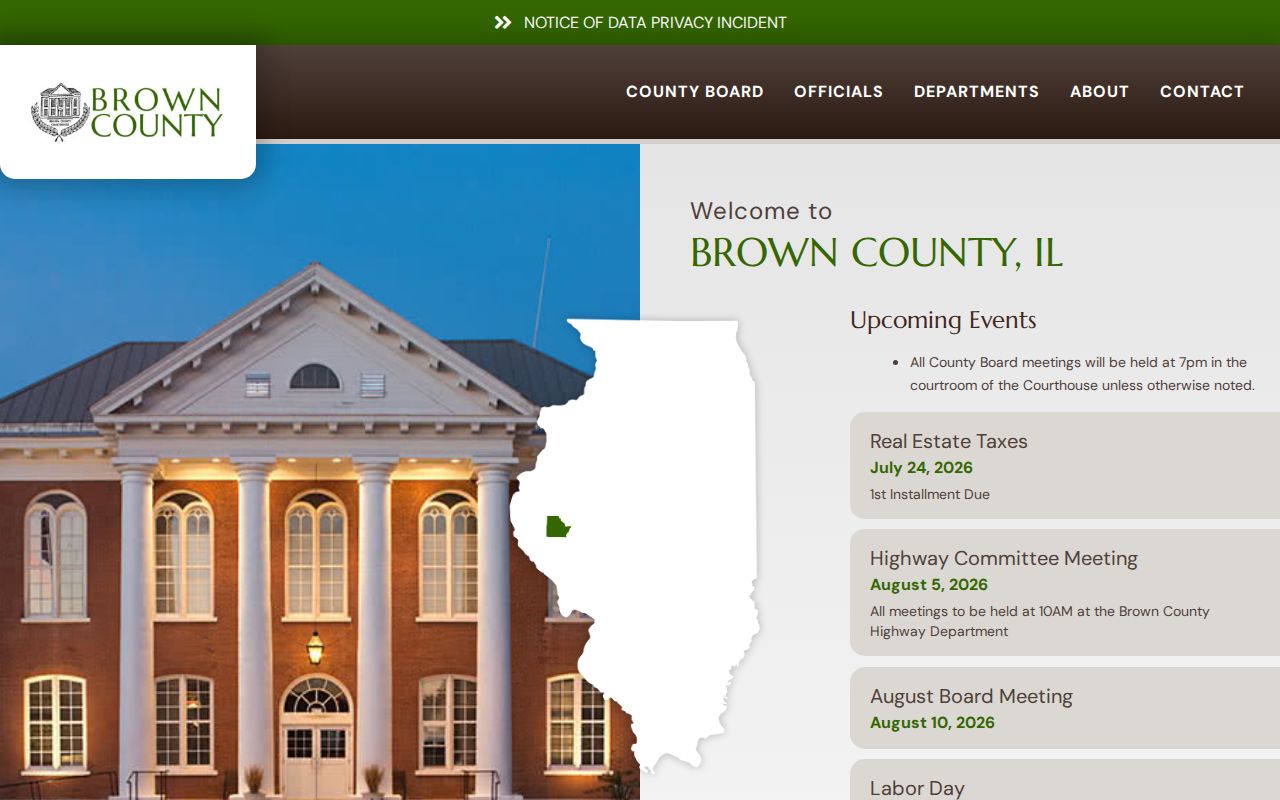
That source is a starting point for dates and offices, while the original sheriff or court file supplies the authoritative detail.
Kinds of Criminal Records
Brown County criminal records are grouped by who created them and what stage they describe. An officer writes the incident or arrest report. A booking agency adds custody, fingerprint, photo, property, and bond data. The State's Attorney decides what counts to file. The Circuit Clerk then maintains the complaint or information, docket, orders, plea, judgment, sentence, and later sealing entries. ISP associates fingerprinted arrest cycles with reported outcomes, while IDOC creates a separate state-custody record after a prison commitment.
A useful result names both the record type and its date. A recent sheriff item may precede court filing. A filed charge can later be amended or dismissed. A closed docket can end in conviction, supervision, acquittal, or another result. Registry and warrant records also answer narrow statutory questions rather than serving as a universal Brown County criminal history.
- Incident and arrest files: agency narratives and the alleged basis for enforcement action.
- Booking files: intake, custody, identification, charge, bond, release, and transfer data.
- Circuit Court cases: filed counts, hearings, orders, outcome, sentence, and costs.
- ISP conviction responses: state-maintained conviction information under the UCIA.
- Custody and registry files: separate IDOC and ISP public systems with limited purposes.
Room 1 or Room 5?
Choose Room 1 when the question concerns a Brown County sheriff incident, arrest, booking, present housing, or warrant check. Choose Room 5 when it concerns a court number, filed charge, hearing, disposition, judgment, certified copy, or expungement and sealing filing. A report does not become a court judgment merely because the prosecutor reviewed it, and the sheriff cannot certify a Circuit Court disposition.
| Question | First Brown County channel | Fallback |
|---|---|---|
| Was an incident reported? | Sheriff weekly report or Room 1 | Focused Illinois FOIA request |
| Was a charge filed? | Public Court Records | Room 5 phone, email, or counter |
| Is a warrant active? | Sheriff verification | Clerk for the public case |
| What was the final outcome? | Circuit Clerk docket | Certified judgment from Room 5 |
Brown County Criminal Records: What They Contain
A Brown County court file can display the county and court, case number, filing date, case type, status, counts, statutes, offense class, judge, attorney appearances, hearing dates, chronological entries, financial balances, disposition, and sentence. An ISP criminal-history response is organized differently. It can group fingerprint-linked arrest cycles with submitted identifiers, agency codes, charges, and reported outcomes. The public UCIA response focuses on convictions; Access and Review is the route for your own broader state record.
| Name & identifiers | Displayed name, aliases where authorized, birth data, submitted descriptors, SID, FBI number, or case number. |
|---|---|
| Arrest / booking data | Arrest date, agency, alleged charge, booking time, fingerprints or transaction control number, custody, bond, release, or transfer. |
| Charges & statutes | Each count as arrested or filed, its Illinois citation, description, and offense class. |
| Disposition | Dismissal, acquittal, supervision, plea, verdict, conviction, or other outcome, with date when reported. |
| Sentence | Jail, prison, probation, supervision, fine, costs, and related orders as the court records them. |
| Custody / supervision | County custody must be checked with the sheriff; state custody and release data come from IDOC. |
CHIRP Versus Brown Case Search
CHIRP and the Brown County court index answer different questions. CHIRP reports conviction information maintained by ISP across Illinois. The local index shows a Brown County judicial case, including public pending charges and public non-conviction results. Neither contains the sheriff's full incident narrative. A person reviewing their own history should compare the state response with the local docket and obtain a certified disposition when the state outcome appears wrong or missing.
- Supervision
- A court outcome that can follow a guilty plea but is treated as a non-conviction disposition in the circumstances Illinois law defines.
- Disposition
- The result assigned to a count, such as dismissal, acquittal, supervision, or conviction.
- Closed
- A docket status showing that active case work ended, not a statement that the result was a conviction.
- Arrest cycle
- A fingerprint-linked group of arrest and outcome data maintained in the state repository.
Brown County's State's Attorney describes local supervision as common in eligible traffic and misdemeanor matters, subject to court approval, and generally unavailable for felonies. The office notes a typical local term of three months, with possible periods up to two years. Read the actual order because eligibility and terms turn on the case.
Illinois Public Access Laws
Illinois law separates executive-agency records, court files, state conviction information, juvenile material, and registry data. The Illinois Freedom of Information Act governs requests to the sheriff and other public bodies. It generally calls for a response to a noncommercial request within five business days, subject to a statutory five-business-day extension. Court files follow judicial access rules and must be ordered from the Circuit Clerk rather than converted into county-board FOIA records.
Key Statutes:
5 ILCS 140 sets the FOIA request, response, fee, exemption, and denial framework.
20 ILCS 2635 makes ISP conviction information public while defining its scope and correction policy.
20 ILCS 2630/5.2 controls Illinois expungement, sealing, and qualifying automatic sealing.
730 ILCS 150/3 states key sex offender registration duties and deadlines.
Brown County Warrant Verification
Brown County publishes no complete online active-warrant list. A missing entry in Public Court Records or the sheriff archive does not prove that no warrant exists. Call the Sheriff at 217-773-2061 extension 1 to verify identity and status, then ask the Circuit Clerk about the underlying public case. Bench warrants can follow a missed appearance or unmet order. Arrest warrants can begin a case, while search warrants serve a different investigative purpose and may remain sealed.
If a warrant may concern you, confirm the case and get legal advice before appearing without a plan. Ask about bond and appearance instructions, follow only confirmed surrender directions, retain receipts and court orders, and recheck the docket after the warrant is quashed. Illinois law enforcement uses systems that are not open public self-search portals. Brown County has no verified warrant app or amnesty program.
Note: A public docket can lag a new or recently quashed warrant, so direct verification is the safer route.
Restricted, Sealed & Expunged Records
Illinois distinguishes expungement from sealing. Expungement removes or destroys a qualifying record as the statute directs. Sealing retains the record but hides it from most public access. Arrests without charges, acquittals, dismissals, reversed convictions, and some supervision outcomes may qualify for expungement after applicable waits. Many convictions may be sealable, but offense-specific exclusions apply. A portal result alone cannot establish eligibility.
Use the Illinois Courts approved form set and file Brown County matters through Room 5. The local filing fee is not published, so ask the clerk before filing. ISP lists a $60 fee to process a court order to expunge or seal criminal history, though it charges no fee for the petition itself. Juvenile files, protected victim data, private identifiers, and sealed material have separate limits. Verify the result in both clerk and ISP systems after processing.
The Illinois Courts page provides the approved Brown County expungement and sealing forms.
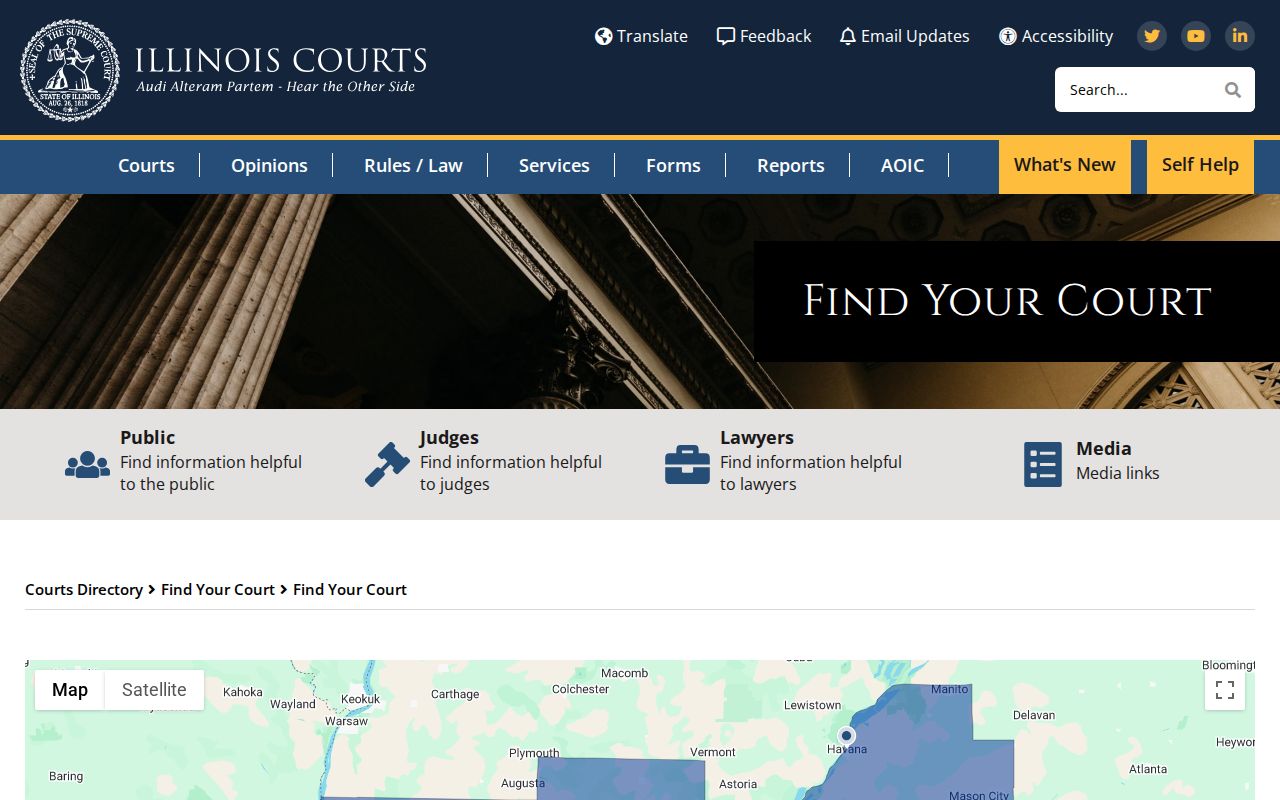
The circuit source confirms Brown County's judicial placement, while Room 5 remains the local filing and certification point.
Brown County Custody Layers
Current local custody begins with the Brown County Sheriff because no official county jail roster or verified facility details were located. Call Room 1 for the current housing location, booking number, bond, and transfer status. VINELink can supplement that call with custody notifications when a participating Illinois record appears. It does not replace direct confirmation, and it does not decide guilt or show the final court outcome.
The IDOC Individuals in Custody search applies after a state commitment. It can search by name or IDOC number and may show physical identifiers, admission and custody status, institution, sentencing county, offense, class, sentence, and projected release data. Federal custody uses the Bureau of Prisons locator. Keeping these layers separate prevents a failed county roster search from being mistaken for release.
City-by-City Criminal Records in Brown County
The official 2020 Census ranks Mt. Sterling, Versailles, and Ripley as Brown County's three largest incorporated places. None has a verified separate public police-record portal or municipal court search in the researched official sources. Local events therefore route through the agency named in the weekly report, most often the sheriff or ISP, and court cases route to the Brown County Circuit Clerk. The city pages keep that county chain brief while explaining each place's distinct roads, scale, and record gaps.
Mt. Sterling Record Check
1,888 · County-seat records route through the courthouse and the named arresting agency.
Versailles Record Check
478 · Sheriff reports and the Brown County court index are the core public channels.
Ripley Record Check
52 · Sheriff-first incident routing leads to the circuit docket in Mt. Sterling.
Correcting Brown County Record Gaps
A missing state disposition can leave a fingerprint-linked arrest cycle unclear. First obtain the certified judgment or dismissal from the Brown County Circuit Clerk. Keep the case number, document title, and certification request precise because the clerk does not publish a criminal-copy fee schedule. Then retain the ISP response number and transaction control number and follow ISP Access and Review to inspect and challenge your own record.
The court and repository update on different tracks. Automatic sealing also does not remove the need to verify both systems. If a public case image is absent, call or email Room 5 rather than assuming the document does not exist. If the error is in an arrest narrative, direct the request to the arresting agency. Each correction must go back to the custodian that can amend that record.
Brown County Scale and Context
Brown County covers 307 square miles. The 2020 Census counted 6,244 residents, and the Census estimate reached 6,401 in 2025. Those figures help explain why the county relies on one courthouse, a weekly report archive, and state systems instead of several specialized local portals. They do not support a crime rate by themselves. A valid rate needs a defined year, reporting coverage, agency scope, and population base.
The 2020 Census files provide the stable official basis for Brown County and its small-place ranking.
Population context explains the shared record system, but it should not be mixed with custody counts at the Western Illinois Correctional Center.
For crime data, query the agency and year through official ISP Crime in Illinois publications or the FBI Crime Data Explorer. Sheriff activity posts often mention US 24 and Illinois routes 99 and 107, yet selected reports cannot be summed into a complete county trend. Reporting gaps and institutional populations can distort a quick comparison.
The FBI Crime Data Explorer is the official federal query layer for agency and county data.
Read the selected year and agency coverage before drawing any conclusion about Brown County criminal activity.